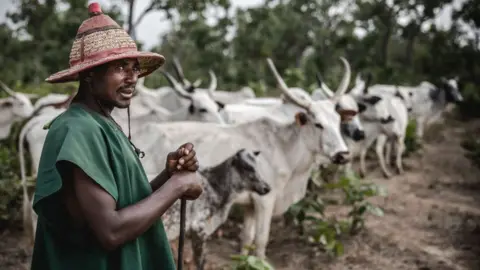
The Concerned Fulani People of Nigeria has urged United States authorities and other international stakeholders to avoid framing insecurity in Nigeria as being driven by any single ethnic group, warning that such interpretations risk worsening tensions across the country.
In a statement issued on Thursday and signed by Ibrahim Barkindo Chubado, the group responded to recent foreign assessments and public commentary on Nigeria’s security challenges, particularly those referencing Fulani herders in discussions on banditry and armed violence.
The group argued that recurring references linking Fulani identity to insecurity reflect what it described as a pattern of selective interpretation that ignores the wider complexity of violence in Nigeria.
“The Concerned Fulani People of Nigeria is deeply concerned about the continued portrayal of our ethnic group as the singular source of insecurity in Nigeria,” the statement said. “Such narratives are not only misleading but also dangerous in a multi-ethnic society like ours.”
It questioned what it called inconsistencies in international reporting on Nigeria’s security situation, especially earlier assessments that cautioned against ethnic generalisations while recent narratives, according to the group, appear to shift toward profiling Fulani communities.
According to the statement, such framing has historical consequences. It recalled that during previous administrations, particularly under President Muhammadu Buhari, public discourse often associated insecurity with Fulani identity or religion, a development the group said contributed to hostility against civilians.
It stated that several Fulani settlements in parts of southern and north-central Nigeria were subjected to attacks, displacement, and loss of livestock as a result of public suspicion and retaliatory violence.
The group also challenged simplified explanations of farmer-herder conflicts, arguing that the crisis is frequently misrepresented in public discourse. It maintained that the root causes are often economic and environmental rather than ethnic.
“Conflicts involving herders and farmers have been repeatedly reduced to ethnic confrontation,” the statement said. “In reality, security experts have consistently pointed to land scarcity, climate pressure, blocked grazing routes, and local disputes as major drivers.”
The statement referenced states such as Benue, Plateau, and Taraba, where recurring clashes have been recorded. It argued that many Fulani families in these regions have lived there for generations and should not be classified as outsiders or treated collectively as suspects.
It further cited previous policy discussions in Nigeria that recommended structural reforms, including the establishment of ranching systems, improved land-use planning, and stronger enforcement mechanisms as sustainable solutions to recurring conflict between herders and farmers.
The group also pointed to past incidents in Ekiti, Ondo, and Edo States where Fulani communities were initially accused following violent attacks, noting that some of those assumptions were later challenged by security investigations.
A key reference in the statement was the 2022 attack on St. Francis Catholic Church in Owo, Ondo State. The group said early public reactions wrongly attributed the incident to Fulani herders before Defence Headquarters later linked it to criminal elements associated with an Ebira subgroup.
“Despite subsequent clarifications by security authorities, some members of our communities continued to face profiling and arrests,” the statement noted.
The group also reacted strongly to reports attributed to the United States Commission on International Religious Freedom (USCIRF), which allegedly claimed that around 30,000 armed Fulani militants were responsible for insecurity in Nigeria.
It described the figure as unverified and the framing as harmful. “Such claims amount to unfair stereotyping that risks inflaming ethnic relations and undermining peacebuilding efforts,” it said.
According to the statement, insecurity in Nigeria involves multiple actors operating across different regions, including armed criminal groups, insurgents, and separatist movements. It argued that attributing violence to a single ethnic or religious identity oversimplifies a complex national challenge.
“Banditry, terrorism, kidnapping, separatist agitation, and communal violence cannot be reduced to the identity of one group,” the statement said.
The group called on international institutions, including US-based policy bodies, to adopt evidence-based reporting standards when analysing Nigeria’s security situation. It also urged Nigerian authorities to strengthen justice systems in ways that discourage collective blame.
“Nigeria’s future cannot be built on ethnic scapegoating, mutual suspicion or divisive narratives,” the statement concluded. “What is required is fairness, accountability, and a commitment to national unity grounded in facts rather than assumptions.”