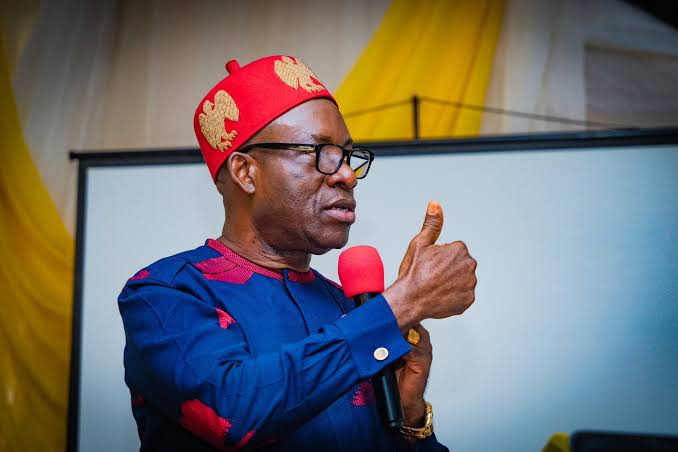
Governor Chukwuma Soludo is one of Nigeria's most accomplished public intellectuals. As a former Central Bank Governor, economist, professor, and now governor of Anambra State, his views naturally attract attention and command respect. It is precisely because of his stature that his reported statement that "the South East only contributes 8% to Nigeria's GDP, so if the South East were to collapse tomorrow Nigeria will not be affected; they will only see it as a human disaster and move on" deserves careful examination.
Whether intended as a hard economic truth or a wake-up call to the people of the South East, the statement is problematic on several levels. It is factually questionable, strategically unhelpful, politically dangerous, and diplomatically unbecoming of a leader entrusted with advancing the interests of his people.
The first problem lies in the assumption that the importance of a region can be measured solely by the percentage of national GDP officially attributed to it. Such a view is economically reductionist and ignores the complexity of modern economies. GDP statistics capture only a portion of economic reality. They do not fully account for the extensive commercial networks built by South Eastern entrepreneurs across Nigeria. They do not adequately reflect the economic activities of millions of traders, industrialists, transporters, professionals, and investors who operate outside the geographical boundaries of the South East. Nor do they capture the enormous contribution of the informal sector, which remains a significant component of Nigeria's economy.
A substantial proportion of businesses owned by people from the South East are located in Lagos, Abuja, Kano, Port Harcourt, Kaduna, and other parts of the federation. The economic output of these enterprises is credited to the states in which they operate rather than to the South East itself. As a result, official regional GDP figures often understate the true economic footprint of the South East within the Nigerian economy.
More importantly, the relevance of a region to a nation cannot be measured by GDP alone. Geopolitical significance is determined by a combination of factors, including entrepreneurship, human capital, innovation, educational attainment, cultural influence, strategic location, political importance, and integration into national economic networks.
The South East has long been one of Nigeria's foremost reservoirs of entrepreneurial talent. Across virtually every state of the federation, businesses from the region drive commerce, facilitate distribution chains, create jobs, stimulate local economies, and contribute to national productivity. The influence of the region extends far beyond what can be captured in a GDP spreadsheet.
History is replete with examples showing that statistics alone do not determine significance. Some of the world's most influential regions and peoples have exerted outsized economic, cultural, intellectual, and political influence far beyond what their numerical economic contributions would suggest. Economic indicators are useful tools for policy analysis, but they are poor substitutes for a holistic assessment of a people's contribution to national development.
Furthermore, the suggestion that Nigeria would simply move on if the South East were to "collapse" defies economic and political logic. No nation can absorb the collapse of an entire geopolitical zone without profound consequences. Such a catastrophe would disrupt supply chains, commerce, transportation networks, labor markets, investments, tax revenues, and national stability. The idea that the nation would merely regard such a development as a humanitarian tragedy and continue unaffected is, at best, a gross oversimplification.
Beyond its factual weaknesses, the statement is strategically dangerous for the South East itself. Throughout history, successful regions and peoples have advanced their interests by emphasizing their strengths, their strategic value, their productivity, and their potential. They have not done so by publicly portraying themselves as dispensable.
Leadership requires not only the courage to identify challenges but also the wisdom to frame those challenges in a manner that strengthens rather than weakens collective confidence. At a time when the South East continues to advocate for greater federal investment, improved infrastructure, industrial expansion, enhanced security, and a more equitable place within the Nigerian federation, it is difficult to see how publicly suggesting that the region is economically insignificant advances those objectives.
Words matter in public life. Investors listen. Policymakers listen. Political actors listen. Most importantly, citizens listen. When a governor speaks, his words shape perceptions. Statements that diminish the perceived importance of a region can undermine investor confidence, weaken advocacy efforts, and inadvertently lower the morale of the people whose interests he is elected to protect.
Even more troubling is the possibility that such remarks may reinforce existing prejudices and dismissive attitudes toward the South East. Many people in the region believe that it has historically faced structural disadvantages in federal appointments, infrastructure allocation, and political representation. Whether one fully accepts that position or not, it remains a deeply held perception among many citizens.
Against that background, a statement suggesting that Nigeria could comfortably continue if the South East ceased to function risks providing rhetorical ammunition to those who already underestimate the region's importance. Those opposed to increased federal investment in the region may point to such comments as evidence that it is not strategically significant.
In politics, perceptions often become realities. That is why leaders must exercise extreme caution when discussing matters that affect the collective image and standing of their people.
This brings us to the final concern: the issue of leadership communication. Professor Soludo occupies the rare position of being both an accomplished academic and a sitting governor. The demands of those two roles are not always the same. Academic discourse often rewards provocative arguments and intellectual disruption. Political leadership requires a greater measure of prudence, diplomacy, and strategic communication.
Governors are expected not merely to describe reality but to inspire confidence, attract investment, build consensus, and advance the interests of their constituents. Even when highlighting economic shortcomings, the language chosen should motivate action rather than project insignificance.
A more constructive message might have been that the South East currently contributes less to Nigeria's GDP than its immense entrepreneurial potential warrants and that the region must pursue policies that unlock greater economic growth and competitiveness. Such a formulation would have communicated urgency without inadvertently diminishing the region's value.
No one doubts Professor Soludo's intellect, credentials, or commitment to development. The issue is not whether he intended to provoke thought. The issue is whether the statement, as reported, serves the strategic interests of the people he leads.
The real question is not whether the South East contributes 8 percent, 10 percent, or 15 percent of Nigeria's GDP. The real question is whether any fair-minded observer can deny the enormous role of the region in Nigerian commerce, entrepreneurship, innovation, education, and national development.
Nations are not built by statistics alone; they are built by people. By any reasonable measure, the region remains one of the most consequential, productive, and influential parts of the Nigerian federation.
The challenge before it is not to prove its relevance, but to continue demonstrating through enterprise, innovation, and leadership that its contributions to national development remain indispensable.
Prof. Anthony Ejiofor is an academic, public intellectual, and community leader engaged in issues of governance, development, and the future of Nigeria and Africa.