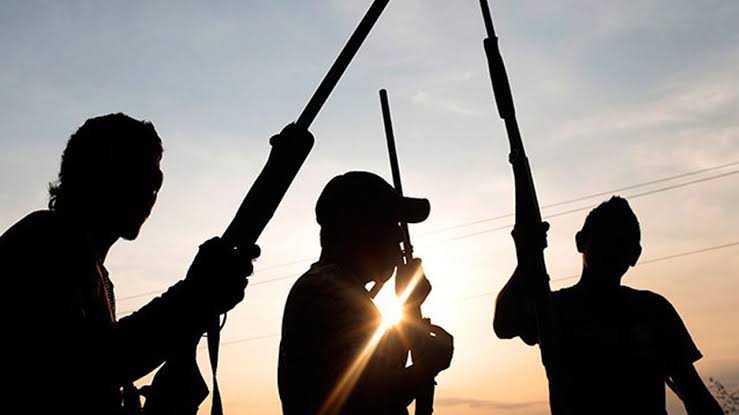

An insider within the security agency said the suspects were picked up in a series of coordinated operations that also led to the recovery of a significant cache of military-grade weapons. According to the source, operatives recovered 15 AK-103 assault rifles, 15 magazines, and 1,434 rounds of 7.62mm live ammunition concealed in a vehicle allegedly used by the suspects. The arrests were made after weeks of surveillance and tracking of suspected arms movements across northern corridors.
Two of the suspects were identified as Yusuf Mohammed, also known as Bature, and Mubarak Ibrahim. Security officials allege that both men have links to Jama’atu Ahlis Sunna Lidda’awati wal-Jihad, a Boko Haram splinter network that has remained active in parts of northern Nigeria. The source described Yusuf Mohammed as a wanted figure within the group’s structure. Both men were reportedly intercepted along the Zaria-Kaduna highway while transporting what investigators believe was a weapons consignment destined for insurgent commanders operating across the north-west and north-central regions.
Further intelligence-led action, according to the same source, led to the arrest of two additional suspects, Goni Ibrahim and Tukur Sani. Goni Ibrahim is believed to be an arms courier operating across the Diffa Region of Niger, a cross-border zone that has long been associated with smuggling routes and militant mobility between Nigeria and Niger. Investigators say the two were in possession of the concealed weapons shipment at the time of their arrest.
The fifth suspect, identified as Alhaji Adamu, also known as Gado Banufe, was later apprehended in Yauri in Kebbi State. He is described by security officials as a key supplier within a wider arms distribution network spanning Kebbi and neighbouring states. Authorities believe his arrest may provide additional insight into how weapons are procured, stored, and transferred to armed groups operating in forested regions across the country’s north.
Preliminary findings from investigators suggest that the suspects were functioning as intermediaries in a logistics chain that supplied weapons to armed factions involved in multiple high-profile abductions, including the attack on St. Mary’s Catholic school in Papiri, Agwara Local Government Area of Niger State. The November 2025 raid on the school remains one of the most extensive mass kidnappings in recent years, during which more than 300 students and staff were taken from their dormitories in the early hours of the attack.
The armed group responsible for that incident has been linked by security analysts to factions operating in and around the Kainji Lake National Park, a vast forest corridor that spans parts of Niger, Kebbi, and Kwara states. The terrain has become increasingly difficult to police, offering cover for armed groups that move between communities and across state boundaries with limited resistance.
Reports from earlier investigations indicated that the attackers behind the Papiri incident operated through forest routes, moving captives across remote settlements before reaching deeper camps within the Kainji reserve. Some of the released students later told investigators that the abductors identified themselves as members of Boko Haram, reinforcing suspicions of factional involvement rather than isolated criminal gangs.
The security source said the latest arrests represent progress in efforts to map out the support structure behind such attacks. Rather than focusing solely on combat units, investigators are now targeting supply chains that include arms couriers, transport facilitators, and financiers. Officials believe that disrupting these networks may weaken the operational capacity of armed groups responsible for repeated school attacks and rural abductions.
The arrested suspects are also believed to have links with insurgent elements associated with Abubakar Saidu, widely known as Mallam Sadiku, a commander reportedly active within the forested border zones. Analysts have previously identified his network as one of the dominant factions operating in the region, particularly in relation to attacks on soft targets such as schools and isolated rural communities.
The State Security Service has not issued an official public statement detailing the arrests, but internal sources indicate that interrogations are ongoing and that further detentions are possible as investigators expand their search. The focus, according to the source, is on identifying additional collaborators, including those who facilitate cross-border movement of weapons and personnel.
The Papiri abduction, which occurred on 21 November 2025, drew widespread condemnation and renewed scrutiny of security conditions in rural Nigeria. Armed men on motorcycles stormed St. Mary’s Catholic boarding school in the early hours, overwhelming security and dispersing into surrounding forest areas with hundreds of captives. While some students managed to escape during the chaos, many were taken deeper into the bush and held for weeks.
Authorities later confirmed the gradual release of a portion of the abducted students, while others were recovered through negotiations and security pressure. By December 2025, officials announced that all remaining captives had been freed, although questions remained about the full circumstances of their release and the identity of those behind the operation.
Security agencies now appear to be shifting focus toward dismantling the infrastructure that enables such large-scale abductions. The recent arrests, particularly the recovery of assault rifles and ammunition, suggest an emphasis on disrupting the flow of weapons into conflict zones where armed groups continue to operate with mobility and coordination. Investigations are ongoing.