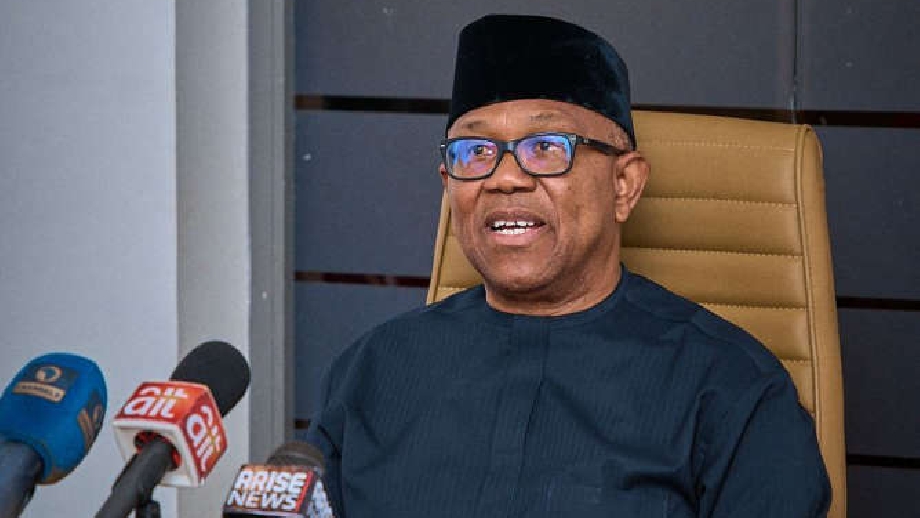
Nigeria Democratic Congress (NDC) presidential candidate Peter Obi has defended his refusal to publicly disclose detailed plans for tackling Nigeria’s electricity and security challenges, insisting that Nigerians should assess him based on his record rather than demand operational specifics.
Obi made the remarks during a podcast interview with broadcaster Rufai Oseni, where he was repeatedly asked to explain how he would achieve key promises if elected president.
During the discussion, Oseni challenged Obi over criticisms that his frequent attacks on President Bola Tinubu’s administration are rarely accompanied by concrete policy alternatives.
Responding to questions about his pledge to increase Nigeria’s electricity generation, transmission and distribution capacity to at least 10,000 megawatts within four years, Obi reiterated his commitment but declined to explain his strategy.
“I have said, and I repeat, that in four years, we will generate, transmit and distribute at least 10,000 megawatts of electricity,” Obi said.
When Oseni pressed him for details on how he intended to meet the target, Obi replied: “No, no, no, I’m not going to tell you how. It is not for you to know how.”
The former Anambra State governor argued that voters should focus on the credibility and track record of a candidate rather than technical explanations.
“It is for you to look at the man who is saying this. Go and check political promises all over the world. You are going to look at who is saying this,” he said.
Obi also criticised the current administration’s performance in the power sector, claiming that campaign promises made before the 2023 election have not translated into significant improvements in electricity generation.
“Somebody just said, if I don’t give you power, don’t vote for me. He didn’t even add one megawatt,” Obi said.
Citing international examples, Obi said countries such as Indonesia, India and Egypt have dramatically increased electricity generation over the past decade.
“If you compare countries like Indonesia, between 2015 and 2025, Indonesia added 70,000 megawatts of electricity. India, within the same period, added 171,000 megawatts. Egypt, within 2015 and 2021, added 28,000,” he said.
According to Obi, he has personally visited power facilities in those countries and understands the policies behind their growth.
“I know what I’m talking about. What those countries do is not rocket science,” he said.
However, when asked again to explain how he would replicate such achievements in Nigeria, Obi maintained his position.
“My commitment is I will deliver it,” he stated.
The interview also focused on Nigeria’s security crisis, including kidnappings, attacks on schools and the killing of security personnel.
Asked what specific measures he would take as commander-in-chief to address insecurity, Obi again declined to reveal details.
“What you’re saying again is, how are you going to do it? I will not tell you,” he said.
Instead, he pointed to his tenure as governor of Anambra State as evidence of his ability to confront criminality.
“I fought criminality in Anambra State. Go and ask people. Head on. You must show commitment,” Obi said.
When challenged on whether commitment alone could solve Nigeria’s security problems, he responded: “Commitment solves the problem of everything.”
Obi also suggested that elements within government institutions may be frustrating efforts to tackle insecurity, echoing concerns previously raised by former President Goodluck Jonathan.
Drawing from his experience in Anambra, he argued that effective governance requires clear authority and decisive leadership.
“It’s one government. It’s either I’m in charge or they’re in charge. One person must be in charge,” he said.
The former presidential candidate added that defeating insecurity would require a wartime mentality among political leaders and security agencies.
“If you’re ready to live, you must be ready to die. If you’re not ready to die, go home,” Obi said.
Declaring his commitment to Nigeria, Obi said he had never sought foreign citizenship despite spending years abroad and would remain loyal to the country regardless of the circumstances.
“God created me a Nigerian and I’m ready to die here,” he said.