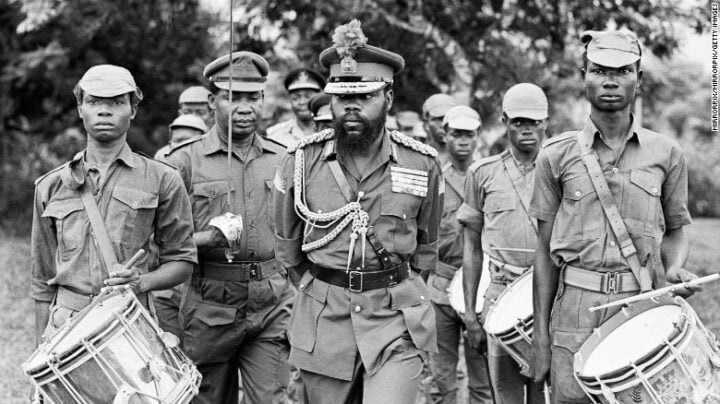
Former Nigerian head of state, Yakubu Gowon, has alleged that Chukwuemeka Odumegwu Ojukwu discussed plans for military intervention in support of Nnamdi Azikiwe during the 1964 political crisis between Azikiwe and Prime Minister Abubakar Tafawa Balewa.
Gowon made the claim in his memoir, *My Life of Duty and Allegiance*, launched in Abuja on Tuesday.
According to Gowon, the discussions took place after the disputed 1964 general election, which triggered a constitutional crisis between Azikiwe and Balewa.
Azikiwe’s party, the National Council of Nigerian Citizens (NCNC), and its allies had boycotted the election in parts of the country over allegations of malpractice against Balewa’s Northern Peoples Congress (NPC).
The crisis escalated when Azikiwe initially refused to invite Balewa to form a government, leaving Nigeria without a head of government for about 24 hours.
Recounting the incident, Gowon said he walked into Ojukwu’s office while searching for Lt-Col. David Ejoor and met Ojukwu alongside Col. Victor Banjo in the middle of what appeared to be a political discussion.
“Without beating about the bush, he said they had been reviewing the conflict between Dr. Nnamdi Azikiwe, the President and Alhaji Abubakar Tafawa Balewa, the Prime Minister and de facto head of government,” Gowon wrote.
He said Ojukwu and Banjo believed the military needed to intervene in the political standoff.
“The two military officers reasoned that if the military did not intervene, one way or the other, particularly in favouring Zik in the unfolding political drama, we might eventually be blamed for whatever happened to the young Nigeria,” he wrote.
Gowon said he became suspicious during the meeting and concluded that the officers were trying to build regional support for possible military action.
“On a deeper reflection, it occurred to me that the basis of the invitation that Ojukwu had cheerfully extended to me was premised on the need to create the picture of a broad-based, ‘national’ military action,” he wrote.
According to Gowon, Ojukwu represented the East, Banjo the West, Ejoor the Mid-West, while he was expected to represent the North.
He said he rejected the proposal because it violated military principles.
“I did not feel comfortable with the subject of their discussion and strongly disagreed with their conclusion,” Gowon wrote.
“We were all trained to be officers in a disciplined Army that was loyal and supportive of the political leadership, that is, the government of the day irrespective of the political party in control.”
Gowon added that he questioned whether the plan was aimed at strengthening Azikiwe’s position or masking a coup plot.
“For me, therefore, any intervention on behalf of Zik, who we all respected but knew was a ceremonial President, was questionable because it would have amounted to a military-aided civilian take-over of government,” he wrote.
“Was this their intention or was it a camouflage for a military coup?”
The former head of state said he warned the officers against taking any action.
“God helps anyone that starts any trouble,” he recalled telling them.
The political crisis of 1964 and the violence that followed in western Nigeria weakened the country’s democracy ahead of the January 1966 coup.
The coup led to the killing of Balewa, Northern Premier Ahmadu Bello, Western Premier Ladoke Akintola and Finance Minister Festus Okotie-Eboh, among others.
The failed coup later brought Johnson Aguiyi-Ironsi to power before the July 1966 counter-coup elevated Gowon as head of state.
Relations between Gowon and Ojukwu later collapsed after Ojukwu declared Biafra’s secession in 1967, leading to the Nigerian civil war that ended in 1970.